

Đề thi thử TN THPT môn Tiếng Anh 12 - Sở GD&ĐT Thái Bình - Trường THPT Phụ Dực - Năm học 2021-2022 (Có đáp án)
 4 trang
26/11/2025
540
4 trang
26/11/2025
540
Bạn đang xem tài liệu "Đề thi thử TN THPT môn Tiếng Anh 12 - Sở GD&ĐT Thái Bình - Trường THPT Phụ Dực - Năm học 2021-2022 (Có đáp án)", để tải tài liệu gốc về máy hãy click vào nút Download ở trên.
Tóm tắt nội dung tài liệu: Đề thi thử TN THPT môn Tiếng Anh 12 - Sở GD&ĐT Thái Bình - Trường THPT Phụ Dực - Năm học 2021-2022 (Có đáp án)
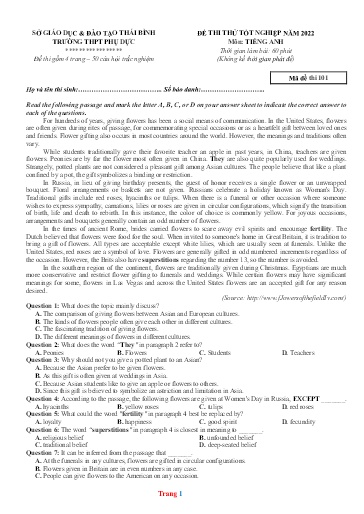
 SỞ GIÁO DỤC & ĐÀO TẠO THÁI BÌNH ĐỀ THI THỬ TỐT NGHIỆP NĂM 2022
 TRƯỜNG THPT PHỤ DỰC Môn: TIẾNG ANH
 ***************** Thời gian làm bài: 60 phút
 Đề thi gồm 4 trang – 50 câu hỏi trắc nghiệm (Không kể thời gian phát đề)
 Mã đề thi 101
Họ và tên thí sinh: .. Số báo danh: ..
Read the following passage and mark the letter A, B, C, or D on your answer sheet to indicate the correct answer to
each of the questions.
 For hundreds of years, giving flowers has been a social means of communication. In the United States, flowers
are often given during rites of passage, for commemorating special occasions or as a heartfelt gift between loved ones
and friends. Flower gifting also occurs in most countries around the world. However, the meanings and traditions often
vary.
 While students traditionally gave their favorite teacher an apple in past years, in China, teachers are given
flowers. Peonies are by far the flower most often given in China. They are also quite popularly used for weddings.
Strangely, potted plants are not considered a pleasant gift among Asian cultures. The people believe that like a plant
confined by a pot, the gift symbolizes a binding or restriction.
 In Russia, in lieu of giving birthday presents, the guest of honor receives a single flower or an unwrapped
bouquet. Floral arrangements or baskets are not given. Russians celebrate a holiday known as Woman's Day.
Traditional gifts include red roses, hyacinths or tulips. When there is a funeral or other occasion where someone
wishes to express sympathy, carnations, lilies or roses are given in circular configurations, which signify the transition
of birth, life and death to rebirth. In this instance, the color of choice is commonly yellow. For joyous occasions,
arrangements and bouquets generally contain an odd number of flowers.
 In the times of ancient Rome, brides carried flowers to scare away evil spirits and encourage fertility. The
Dutch believed that flowers were food for the soul. When invited to someone's home in Great Britain, it is tradition to
bring a gift of flowers. All types are acceptable except white lilies, which are usually seen at funerals. Unlike the
United States, red roses are a symbol of love. Flowers are generally gifted in odd numbered increments regardless of
the occasion. However, the Brits also have superstitions regarding the number 13, so the number is avoided.
 In the southern region of the continent, flowers are traditionally given during Christmas. Egyptians are much
more conservative and restrict flower gifting to funerals and weddings. While certain flowers may have significant
meanings for some, flowers in Las Vegas and across the United States flowers are an accepted gift for any reason
desired.
 (Source:
Question 1: What does the topic mainly discuss?
 A. The comparison of giving flowers between Asian and European cultures.
 B. The kinds of flowers people often give each other in different cultures.
 C. The fascinating tradition of giving flowers.
 D. The different meanings of flowers in different cultures.
Question 2: What does the word “They" in paragraph 2 refer to?
 A. Peonies B. Flowers C. Students D. Teachers
Question 3: Why should not you give a potted plant to an Asian?
 A. Because the Asian prefer to be given flowers.
 B. As this gift is often given at weddings in Asia.
 C. Because Asian students like to give an apple or flowers to others.
 D. Since this gift is believed to symbolize an astriction and limitation in Asia.
Question 4: According to the passage, the following flowers are given at Women's Day in Russia, EXCEPT _______.
 A. hyacinths B. yellow roses C. tulips D. red roses
Question 5: What could the word "fertility" in paragraph 4 best be replaced by?
 A. loyalty B. happiness C. good spirit D. fecundity
Question 6: The word “superstitions" in paragraph 4 is closest in meaning to _______.
 A. religious belief B. unfounded belief
 C. traditional belief D. deep-seated belief
Question 7: It can be inferred from the passage that _______.
 A. At the funerals in any cultures, flowers are gifted in circular configurations.
 B. Flowers given in Britain are in even numbers in any case.
 C. People can give flowers to the American on any occasion.
 Trang 1
 D. Egyptians are rather comfortable when receiving flowers at funerals and weddings.
Mark the letter A, B, C, or D on your answer sheet to indicate the sentence that best combines each pair of
sentences in the following questions.
Question 8: He doesn't have any money now. He can't lend his friend some.
 A. If only he had had money now and could have lent his friend some.
 B. If he has much money now, he can lend his friend some.
 C. He wishes he had money now and could lend his friend some.
 D. As long as he has much money now, he can lend his friend some.
Question 9: “I visited my uncle in Hanoi last week,” Mark said.
 A. Mark said that I visited my uncle in Hanoi the previous week.
 B. Mark said that he would visit his uncle in Hanoi last week.
 C. Mark said that I had visited my uncle in Hanoi last week.
 D. Mark said that he had visited his uncle in Hanoi the previous week.
Question 10: It is unnecessary for you to finish the report until tomorrow afternoon
 A. You should finish the report until tomorrow afternoon
 B. You have to finish the report unitl tomorrow afternoon.
 C. You may finish the report after tomorrow afternoon.
 D. You needn’t finish the report until tomorrow afternoon.
Mark the letter A, B, C or D on your answer sheet to indicate the most suitable response to complete each of the
following exchanges.
Question 11: Linda and Janet are talking about family living under one roof.
Linda: “I think it’s a good idea to have three or four generations living under one roof. They can help one another.”
Janet: “___________. Many old-aged parents like to lead independent life in a nursing home.”
 A. It’s nice to hear that B. That’s not true
 C. I agree with you completely D. Me, too.
Question 12: Peter and Susan are in the room. Peter wants to watch T.V.
- Peter: “Do you mind if I put the television on?”
- Susan: “______”
 A. It’s no matter to me. B. No, not in the least.
 C. Not mention it. D. You are welcome.
Read the following passage and mark the letter A, B, C, or D on your answer sheet to indicate the correct word or
phrase that best fits each of the numbered blanks.
 GOOD FRIENDS
Psychologists have long known that having a set of cherished companions is crucial to mental well- being. A recent
study by Australian investigators concluded that our friends even help to (13) _______ our lives. The study
concentrated on the social environment, general health, and lifestyle of 1,477 persons older than 70 years. The
participants were asked how (14) _______ contact they had with friends, children, relatives and acquaintances.
Researchers were surprised to learn that friendships increased life (15) _______ to a far greater extent than frequent
contact with children and other relatives. This benefit held true even after these friends had moved away to another
city and was independent of factors such as socio- economic status, health, and way of life. According to scientists, the
ability to have relationships with people to (16) _______ one is important has a positive effect on physical and mental
health. Stress and tendency towards depression are reduced, and behaviours that are damaging to health, such as
smoking and drinking, occur less frequently. (17) _______ , our support networks, in times of calamity in particular,
can raise our moods and feelings of self-worth and offer helpful strategies for dealing with difficult personal
challenges.
 (Source: Academic Vocabulary in Use by Michael McCarthy and Felicity O'Dell)
Question 13: A. stretch B. expand C. lengthen D. prolong
Question 14: A. many B. lots of C. much D. few
Question 15: A. assurance B. expectancy C. insurance D. expectation
Question 16: A. whom B. that C. what D. who
Question 17: A. Otherwise B. For example C. Moreover D. However
Mark the letter A, B, C, or D on your answer sheet to indicate the word(s) OPPOSITE in meaning to the underlined
word(s) in each of the following questions.
Question 18: At first, no one believed she was a pilot, but her documents lent colour to her statements.
 A. borrowed colour from B. provided evidence for
 C. gave no proof of D. got information from
Question 19: The mountainous region of the country is thinly populated. It has only 300 inhabitants.
 A. densely B. largely C. greatly D. sparsely
Mark the letter A, B, C, or D on your answer sheet to indicate the sentence that is closest meaning to each of the
following questions.
 Trang 2
Question 20: He never suspected that she engaged in political conspiracies.
 A. At no time did he suspect that she engaged in political conspiracies.
 B. What he thought was she engaged in political conspiracies.
 C. Never before he had suspected that she engaged in political conspiracies.
 D. He used to think that she engaged in political conspiracies.
Question 21: He last cooked for the whole family five months ago.
 A. He has cooked for the whole family for five months.
 B. He hasn’t cooked for the whole family for five months.
 C. He didn’t cook for the whole family five months ago.
 D. He would cook for the whole family in five months.
Read the following passage and mark the letter A, B, C, or D on your answer sheet to indicate the correct answer to
each of the questions.
 Instructors at American colleges and universities use many different teaching methods. Some instructors give
assignments every day. They grade homework. Students in their classes have to take many quizzes, a midterm exam,
and a final test. Other instructors give only writing assignments. Some teachers always follow a course outline and
usually use the textbooks. Others send students to the library for assignments.
 The atmosphere in some classrooms is very formal. Students call their instructors “Professor Smith”, “Mrs.
Jones”, and so on. Some teachers wear business clothes and give lectures. Other classrooms have an informal
atmosphere. Students and teachers discuss their ideas. Instructors dress informally, and students call them by their first
names. American teachers are not alike in their teaching styles.
 At most American colleges and universities, facilities for learning and recreation are available to students.
Students can often use recorders, video machines, and computers at libraries and learning centres. They can buy
books, notebooks, and other things at campus stores. They can get advice on their problems from counsellors and
individual help with their classes from tutors. Students can relax and have fun on campus, too. Some schools have
swimming pools and tennis courts. Most have snack bars or cafeterias.
 (Source. Adapted from
Question 22: What is the main idea of the first paragraph?
 A. Ways of using the textbook B. Ways of giving assignments
 C. Ways of teaching D. Ways of taking an exam
Question 23: What does the phrase “business clothes” in paragraph 2 mean?
 A. clothes for business people B. casual clothes
 C. formal clothes D. trendy clothes
Question 24: Where do students and teachers discuss their idea?
 A. In classrooms with informal atmosphere
 B. At libraries
 C. At learning centers
 D. In classrooms with formal atmosphere
Question 25: What can’t students do at most American colleges and universities?
 A. They can’t use the computers that are linked to libraries.
 B. They can’t have tutors and counselors solved their problems.
 C. They can’t ask their counselors and tutors for advice.
 D. They can’t buy anything at campus stores.
Question 26: Which of the following statements is NOT true about schools in America?
 A. They have stores on campus.
 B. They offer sports and leisure facilities for students.
 C. They have no recreation facilities.
 D. They are well-equipped.
Mark the letter A, B, C, or D on your answer sheet to indicate the word whose underlined part differs from the
other three in pronunciation in each of the following questions.
Question 27: A. stopped B. wanted C. cooked D. searched
Question 28: A. hand B. stay C. cake D. face
Mark the letter A, B, C, or D on your answer sheet to indicate the correct answer to each of the following questions.
Question 29: Mr. Black didn’t go to work yesterday, _________?
 A. didn’t he B. won’t he C. doesn’t he D. did he
Question 30: _______ an artist becomes, the more difficult it is for him to avoid reporters.
 A. The more famously B. The most famous C. More famous D. The more famous
Question 31: When preparing a CV, university ___________ can consider attaching a separate report about official
work experience during the course.
 A. applicants B. leavers C. graduates D. candidates
Question 32: _______ the promotion, I began to search for other goals.
 Trang 3
 A. Being attained B. Having attained C. To attain D. Attained
Question 33: His achievements were partly due to the __________ of his wife.
 A. assisted B. assist C. assistant D. assistance
Question 34: By the time you come here tomorrow, the work ___________.
 A. will be finished B. will be finishing
 C. will have been finishing D. will have been finished
Question 35: The flood victims ________ with food and clean water by the volunteers.
 A. were providing B. were provided C. provide . D. provided
Question 36: She bought a _________ jacket as a present for her daughter.
 A. new Italian leather B. leather new Italian
 C. new leather Italian D. leather Italian new
Question 37: What measures have been _________ to control traffic jam at rush hours?
 A. done B. imagined C. taken D. carried
Question 38: My college graduation was a real__________ day for my whole life.
 A. red brick B. red ink C. red letter D. red tape
Question 39: Remember to _________your shoes when you are in a Japanese house.
 A. take off B. take on C. take out D. take over
Question 40: Please send a reply to the wedding invitation in order to__________ your attendance.
 A. reassure B. confirm C. assure D. guarantee
Question 41: While she was taking her exams, she __________ a terrible headache.
 A. is having B. had C. has D. will have
Question 42: _______ his physical disability, he managed to finish the course with good results.
 A. Despite B. Although C. Because of D. Because
Question 43: Neil Armstrong was the first man to walk on the moon __________ 20thJuly 1969.
 A. in B. on C. of D. at
Mark the letter A, B, C, or D on your answer sheet to indicate the underlined part that needs correction in each of
the followingquestions.
Question 44: Judo players are respective to their opponents and bow to each other before and after a contest.
 A. bow to B. their C. each other D. respective
Question 45: Most workers seems to be happy with their new working conditions .
 A. new B. with C. seems D. conditions
Question 46: Each of the beautiful cars in the shop was quickly sold to their owner.
 A. quickly B. their C. each D. cars
Mark the letter A, B, C, or D on your answer sheet to indicate the word that differs from the rest in the position of
the primary stress in each of the following questions.
Question 47: A. different B. confident C. informal D. negative
Question 48: A. device B. marriage C. monkey D. safety
Mark the letter A, B, C, or D on your answer sheet to indicate the word(s) CLOSEST in meaning to the underlined
word(s) in each of the following questions.
Question 49: He had never experienced such discourtesy towards the president as it occurred at the annual meeting in
May.
 A. encouragement B. rudeness C. politeness D. measurement
Question 50: In times of war, the Red Cross is dedicated to reducing the sufferings of wounded soldiers, civilians and
prisoners of war.
 A. interested B. excited C. devoted D. mounted
 ------ The end ------
 ĐÁP ÁN
1 C 6 B 11 B 16 A 21 B 26 C 31 C 36 A 41 B 46 B
2 A 7 C 12 B 17 C 22 C 27 B 32 B 37 C 42 A 47 C
3 D 8 C 13 D 18 C 23 C 28 A 33 D 38 C 43 B 48 A
4 B 9 D 14 C 19 A 24 A 29 D 34 D 39 A 44 D 49 B
5 D 10 D 15 B 20 A 25 B 30 D 35 B 40 B 45 C 50 C
 Trang 4
File đính kèm:
- de_thi_thu_tn_thpt_mon_tieng_anh_12_so_gddt_thai_binh_truong.pdf
