

Đề thi thử TN THPT môn Tiếng Anh 12 (Lần 3) - Sở GD&ĐT Bắc Ninh - Năm học 2021-2022 (Có đáp án)
 26 trang
26/11/2025
520
26 trang
26/11/2025
520
Bạn đang xem tài liệu "Đề thi thử TN THPT môn Tiếng Anh 12 (Lần 3) - Sở GD&ĐT Bắc Ninh - Năm học 2021-2022 (Có đáp án)", để tải tài liệu gốc về máy hãy click vào nút Download ở trên.
Tóm tắt nội dung tài liệu: Đề thi thử TN THPT môn Tiếng Anh 12 (Lần 3) - Sở GD&ĐT Bắc Ninh - Năm học 2021-2022 (Có đáp án)
SỞ GIÁO DỤC VÀ ĐÀO TẠO ĐỀ THI THỬ TỐT NGHIỆP THPT LẦN 3
 TỈNH BẮC NINH MƠN TIẾNG ANH (Năm học 2021-2022)
 Thời gian làm bài: 60 phút
Read the following passage and mark the letter A, B, C, or D to indicate the correct answer to each of
the questions.
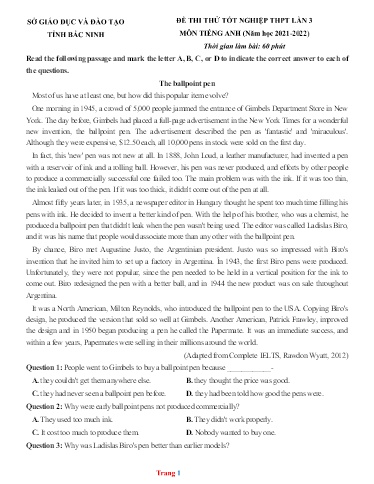
 The ballpoint pen
 Most of us have at least one, but how did this popular item evolve?
 One morning in 1945, a crowd of 5,000 people jammed the entrance of Gimbels Department Store in New
York. The day before, Gimbels had placed a full-page advertisement in the New York Times for a wonderful
new invention, the ballpoint pen. The advertisement described the pen as 'fantastic' and 'miraculous'.
Although they were expensive, $12.50 each, all 10,000 pens in stock were sold on the first day.
 In fact, this 'new' pen was not new at all. In 1888, John Loud, a leather manufacturer, had invented a pen
with a reservoir of ink and a rolling ball. However, his pen was never produced, and efforts by other people
to produce a commercially successful one failed too. The main problem was with the ink. If it was too thin,
the ink leaked out of the pen. If it was too thick, it didn't come out of the pen at all.
 Almost fifty years later, in 1935, a newspaper editor in Hungary thought he spent too much time filling his
pens with ink. He decided to invent a better kind of pen. With the help of his brother, who was a chemist, he
produced a ballpoint pen that didn't leak when the pen wasn't being used. The editor was called Ladislas Biro,
and it was his name that people would associate more than any other with the ballpoint pen.
 By chance, Biro met Augustine Justo, the Argentinian president. Justo was so impressed with Biro's
invention that he invited him to set up a factory in Argentina. Ỵn 1943, the first Biro pens were produced.
Unfortunately, they were not popular, since the pen needed to be held in a vertical position for the ink to
come out. Biro redesigned the pen with a better ball, and in 1944 the new product was on sale throughout
Argentina.
 It was a North American, Milton Reynolds, who introduced the ballpoint pen to the USA. Copying Biro's
design, he produced the version that sold so well at Gimbels. Another American, Patrick Frawley, improved
the design and in 1950 began producing a pen he called the Papermate. It was an immediate success, and
within a few years, Papermates were selling in their millions around the world.
 (Adapted from Complete IELTS, Rawdon Wyatt, 2012)
Question 1: People went to Gimbels to buy a ballpoint pen because ____________-
 A. they couldn't get them anywhere else. B. they thought the price was good.
 C. they had never seen a ballpoint pen before. D. they had been told how good the pens were.
Question 2: Why were early ballpoint pens not produced commercially?
 A. They used too much ink. B. They didn't work properly.
 C. It cost too much to produce them. D. Nobody wanted to buy one.
Question 3: Why was Ladislas Biro's pen better than earlier models?
 Trang 1
 A. It didn't need to be filled with ink as often. B. It was easier to use.
 C. It was designed by a chemist. D. The ink stayed in the pen until it was needed.
Question 4: Biro's first commercially-produced pen
 A. only worked if used in a certain way.
 B. was produced in a factory owned by the Argentinian president.
 C. was a major success.
 D. went on sale in 1944.
Question 5: Patrick Frawley's pen ________________
 A. was the USA's first commercially successful ballpoint pen.
 B. took time to become successful.
 C. was a better version of an earlier model.
 D. was only successful in the USA.
Mark the letter A, B, C, or D to indicate the sentence that best combines each pair of sentences in the
following questions.
Question 6: He isn't qualified. He is not given important tasks.
 A. If only he were qualified and wouldn't be given important tasks.
 B. He wished he hadn't been qualified and wouldn't have been given important tasks.
 C. If he were qualified, he would never be given important tasks.
 D. He wishes he were qualified and would be given important tasks.
Question 7: He started working in the World Bank. That was right after he had graduated from university.
 A. No sooner had he started working in the World Bank than he graduated from university.
 B. Before he graduated from university, he had started working in the World Bank.
 C. No sooner had he graduated from university than he started working in the World Bank.
 D. Hardly had he started working in the World Bank when he graduated from university.
Mark the letter A, B, C or D to indicate the underlined part that needs correction in each of the
following questions.
Question 8: All camp attendants were sent a questionnaire eliciting demographic details, symptoms and
possible exposures, including food history and contact with other cases.
 A. and B. camp attendants C. eliciting D. exposures
Question 9: Scientists think there is water on Mars a long time ago.
 A. a B. on C. is D. think
Question 10: Voters and policymakers should hold school districts and its employees accountable for student
learning
 A. should hold B. accountable C. student learning D. its
Mark the letter A, B, C, or D on your answer sheet to indicate the word(s) OPPOSITE in meaning to
 Trang 2
the underlined word(s) in each of the following questions.
Question 11: We racked our brains but we couldn't come up with a solution.
 A. positively changed B. thought very hard
 C. thought quickly D. considered carefully
Question 12: Her graceful performance of this traditional art form in the evening session was a real source
of pleasure.
 A. attractive B. effortless C. sophisticated D. inelegant
Mark the letter A, B, C, or D on your answer sheet to indicate the correct answer to each of the
following questions.
Question 13: The growth in employment and wages gives consumers some spending __________ to absorb
the higher cost of energy.
 A. ability B. force C. energy D. power
Question 14: _____________trees around the house on the south and west sides, they can save up to about
$300 a year.
 A. To plant B. Having planted C. They have planted D. Being planted
Question 15: ___________to the nearest city, we will have driven for 5 days.
 A. When we will get B. While we are getting C. As soon as we got D. By the time we get
Question 16: Can I have a glass of water? I have got a ___________in my throat.
 A. duck B. frog C. chick D. goat
Question 17: Nothing, even A.I., can replace teachers __________it will be widely used in classroom.
 A. although B. because of C. despite D. because
Question 18: The 26th Annual Meeting of the Asia-Pacific Parliamentary Forum (APPF) ________in Hanoi
from January 18th to 21st, 2018.
 A. being held B. was held C. held D. will hold
Question 19: The map of the top ten most densely ________ countries in the world includes Monaco,
Singapore, Bahrain, Malta, and Bangladesh.
 A. population B. popularly C. populated D. populate
Question 20: Much of our knowledge about prehistoric animals comes from the study of ________
 A. relics B. artefacts C. ruins D. fossils
Question 21: It's the first time she has enjoyed such a ___________ cake
 A. Christmas tasty chocolate B. tasty Christmas chocolate
 C. chocolate Christmas tasty D. tasty chocolate Christmas
Question 22: He was forced to ______________ his pride and asked if he could have his old job back.
 A. vomit B. chew C. swallow D. digest
Question 23: The longer Karen waited for the exam result, ________________she became.
 Trang 3
 A. most anxious B. the more anxious C. more anxious D. the most anxious
Question 24: You will be brought before the disciplinary panel to ____________ your behavior.
 A. turn down B. take up C. account for D. put down
Question 25: Inspector Moro was determined to get to the __________ of the mystery
 A. ground B. bottom C. tune D. end
Question 26: People are worried ___________ losing their jobs during the Covid-19 pandemic.
 A. about B. of C. at D. over
Question 27: The journey soon became tedious, __________
 A. won't it B. wasn't it C. didn't it D. doesn't it
Mark the letter A, B, C or D to indicate the sentence thar is closest in meaning to each of the following
questions
Question 28: It's possible for us to borrow books from the school library.
 A. We have to borrow books from the school library,
 B. We must borrow books from the school library
 C. We can borrow books from the school library.
 D. We should borrow books from the school library
Question 29: "It's me. I broke your vase." Jane said to Ann.
 A. Jane admitted breaking Ann's vase. B. Jane denied breaking Ann's vase.
 C. Jane accused Ann of breaking her vase. D. Ann prevented Jane from breaking her vase.
Question 30: The last time Susan went to school by bike was one year ago.
 A. Susan didn't go to school by bike one year ago.
 B. Susan went to school by bike for one year.
 C. Susan has gone to school by bike for one year.
 D. Susan hasn't gone to school by bike for one year.
Mark the letter A, B, C or D on your answer sheet to indicate the word CLOSEST in meaning to the
underlined word in each of the following questions.
Question 31: Ha Long Bay has attracted millions of visitors who come to enjoy its breathtaking views and
experience other activities.
 A. unbreathable B. unforgettable C. awe-inspiring D. heartbreaking
Question 32: At first, there was a lot of opposition from the parents of the disabled children as they were not
under the impression that their children could learn anything at all.
 A. didn't believe B. didn't support C. didn't report D. didn't declare
Mark the letter A, B, C, or D to indicate the word whose underlined part differs from the three in
pronunciation in each of the following questions.
Question 33: A. manly B. dangeres C. capable D. ancient
 Trang 4
Question 34: A. foods B. strikes C. creates D. hopes
Read the following passage and mark the letter A, B, C, or D to indicate the correct answer to each of
the questions.
 Perhaps the greatest invention in history is writing. The flexibility of writing is perhaps the key to much of
its power. But it may be that writing's very flexibility can be a curse as well as a blessing. A common
concern with oral histories is the possibility that the truth will get distorted over time and that rumors will
become truth. Written history evidences the same problem.
 Throughout the centuries that writing has existed, forged documents have also existed. An ancient letter
supposedly written by the Roman emperor Constantine in the 4h century A.D. shows that the duration of a
document is not proof of its truth. For many centuries, the Catholic Church relied on this letter to enforce the
legitimacy of its rule and its land. The letter from Constantine stated that he had become a Christian and
donated a portion of his land to the Pope and to future Popes in the Catholic Church. Although it is true that
Constantine converted to Christianity, the letter itself was discovered to be a forgery in the 15th century, and
probably originated in the 8th century.
 In addition to historical documents, great literature has also been forged. William Shakespeare, who died in
1616, is perhaps the most famous author in the world. Wouldn't someone benefit if a long-lost play was
found? In 1796, William Henry Ireland announced that he had indeed found such a play entitled Vortigern.
He sold it to a London theater producer, but as soon as he handed over the script, the producer immediately
realized it was fake. He decided to produce it anyway as an April Fool's Day joke.
 Some fake documents are easily debunked by highly literate people by comparing the suspicious document
to writing that was definitely written by the author in question. If the writing style does not correspond to the
known sample, it is not hard to declare the writing to be fake. However, it is not always so easy to use writing
style, grammatical patterns, and word usage as a basis for identifying the real author of a of William
Shakespeare.
In 1989, literature professor Don Foster identified a poem called "A Funeral Elegy" as the work of William
Shakespeare. The work was added to collections of Shakespeare’s work, but in 2002 it was re- classified as
the work of another writer - and Foster, now aware of his mistake, agreed.
 (Adapted from Reading Explorer 5, Nancy Douglas et al., 2012)
Question 35: The best title for this passage is ____________
 A. Oral History vs. Written History
 B. Types of Record History
 C. How Do We Know If Shakespeare Wrote This?
 D. Reliability and the Written Word
Question 36: According to the passage, why would the flexibility of writing be a curse as well as a blessing?
 A. because power can be abused
 B. because good tools can be difficult to find
 Trang 5
 C. because it cannot prevent forgery
 D. because the truth can cause problems
Question 37: What happened as a result of the forged letter from Constantino?
 A. The Church ruled land that did not belong to it for 1100 years,
 B. Constantine mistakenly donated a portion of his land,
 C. The forger may have deliberately misrepresented the facts.
 D. Constantine converted to Christianity.
Question 38: Which of the following statements would the author probably agree with?
 A. Writing style cannot always identify a forgery,
 B. Oral history is more reliable than written history,
 C. History is full of fake documents, so it is not trustworthy,
 D. Analyzing grammatical patterns and word usage is more reliable.
Question 39: The underlined word "debunked” in the passage is closest in meaning to ___________
 A. destroyed B. laughed at hunked C. proved false D. produced
Question 40: The underlined word "it" in the passage refers to __________
 A. a written text B. the poem C. writing style D. Shakespeare's work
Question 41: Based on the passage, it could be suggested that Don Foster's error was __________
 A. being blind to his bias
 B. purposely misinterpreting the facts
 C. deliberately misrepresenting the facts
 D. mistakenly interpreting the poem
Mark the letter A, B, C or D to indicate the word that differs from the other three in the position of the
primary stress in each of the following questions.
Question 42: A. maximum B. applicant C. inflation D. character
Question 43: A travel B. suggest C. sustain D. involve
Mark the letter A, B, C or D on your answer sheet to indicate the sentence that best completes the
following exchanges.
Question 44: Peter and Mary are talking about social networks.
- Peter: "Using social networks may have negative effects on students.
- Mary: “____________It distracts them from their studies."
 A. That's quite true B. I don't quite agree C. You're wrong D. I'm not sure about that
Question 45: Two high school students, Jane and John, are talking in the school yard.
- Jane: “ _____________”
- John: Thanks a bunch. Got it from my brother on my birthday
 Trang 6
 A. Let's go for a ride on my new motorbike!
 B. I'm bored! How about going out for lunch?
 C. That's a lovely dress you're wearing.
 D. Would you like some more coffee?
Read the following passage and mark the letter A, B, C or D to indicate the correct word that best fits
each of the blanks.
 For the Japanese, Mount Fuji has long been the ultimate symbol of beauty. It is incredibly beautiful when
seen from any (46) __________ at all times of day and in any season. But the mountain does not only play a
major part in the landscape - it has also inspired poets and artists for centuries and has come to be (47)
________ with Japan itself. From the top, the sides of the mountain slope away, then flatten out before
reaching the ground Here, at ground level the foot of the mountain forms an almost perfect circle.
 To the north of Mount Fuji lie the famous 'Five Lakes'. The lakeside area is a sea of colour in spring when
the first trees are flowering, and it is a stunning sight in autumn when the leaves turn first brilliant red, then
many shades of brown. (48) _________, many of the best views of Mount Fuji are from these lakes, (49)
_________still waters reflect the mountain's beautifully symmetrical outline like a mirror. Both Mount Fuji
and its lakes are volcanic (50) _____________ origin, and that is probably why traditional stories say that
Mount Fuji appeared overnight; and, for the same reason, it may one day vanish just as suddenly.
Question 46: A. corner B. curve C. edge D. angle
Question 47: A. named B. identified C. considered D. recognized
Question 48: A. Nevertheless B. Especially
 C. Indeed D. Given
Question 49: A. whose B. that C. where D. which
Question 50: A. by B. in C. with D. of
 (Adapted from FCE 4, Cambridge University Press)
 Trang 7
 BẢNG ĐÁP ÁN
 1. D 2. B 3. D 4. A 5. C 6. D 7. C 8. B 9. C 10. D
 11. C 12. D 13. D 14. B 15. D 16. B 17. A 18. B 19. C 20. D
 21. D 22. C 23. B 24. C 25. B 26. A 27. C 28. C 29. A 30. D
 31. C 32. A 33. A 34. A 35. D 36. C 37. C 38. A 39. C 40. B
 41. A 42. C 43. A 44. A 45. C 46. D 47. B 48. C 49. A 50. B
 HƯỚNG DẪN GIẢI CHI TIẾT
1 (VD)
Kiến thức: Đọc hiểu
Giải thích:
Mọi người đến Gimbels để mua bút bi vì ________
A. họ khơng thể mua chúng ở bất cứ nơi nào khác.
B. họ nghĩ rằng giá cả khá tốt.
C. họ chưa bao giờ nhìn thấy một cây bút bi trước đây.
D. họ đã được bảo là những chiếc bút tốt như thế nào.
Thơng tin: The day before, Gimbels had placed a full-page advertisement in the New York Times for a
wonderful new invention, the ballpoint pen. The advertisement described the pen as 'fantastic' and
'miraculous'.
Tạm dịch: Một ngày trước đĩ, Gimbels đã đăng một trang quảng cáo trên tờ New York Times về một phát
minh mới tuyệt vời là bút bi. Quảng cáo mơ tả chiếc bút này là “tuyệt vời” và “kỳ diệu”.
Choose D.
2 (VD)
Kiến thức: Đọc hiểu
Giải thích:
Tại sao bút bi thời kỳ đầu khơng được sản xuất thương mại?
A. Chúng đã dùng quá nhiều mực.
B. Chúng đã khơng hoạt động đúng cách.
C. Tốn quá nhiều chi phí để sản xuất chúng.
D. Khơng ai muốn mua một cái.
Thơng tin: However, his pen was never produced, and efforts by other people to produce a commercially
successful one failed too. The main problem was with the ink. If it was too thin, the ink leaked out of the pen.
If it was too thick, it didn't come out of the pen at all.
 Trang 8
Tạm dịch: Tuy nhiên, chiếc bút của ơng khơng bao giờ được sản xuất và những nỗ lực của những người
khác để tạo ra một chiếc bút thành cơng về mặt thương mại cũng thất bại. Vấn đề chính là mực. Nếu quá
lỗng, mực sẽ chảy ra khỏi bút. Nếu nĩ quá đặc, nĩ khơng chảy khỏi bút chút nào.
Choose B.
3 (VD)
Kiến thức: Đọc hiểu
Giải thích:
Tại sao bút của Ladislas Biro lại tốt hơn các mẫu trước đĩ?
A. Nĩ khơng cần phải đổ đầy mực thường xuyên.
B. Nĩ dễ dàng để sử dụng hơn.
C. Nĩ được thiết kế bởi một nhà hĩa học.
D. Mực vẫn ở trong bút cho đến khi cần dùng đến.
Thơng tin: With the help of his brother, who was a chemist, he produced a ballpoint pen that didn't leak
when the pen wasn't being used.
Tạm dịch: Với sự giúp đỡ của anh trai mình, một nhà hĩa học, ơng đã sản xuất ra một chiếc bút bi khơng bị
rị rỉ mực khi bút khơng được sử dụng.
Choose D.
4 (VD)
Kiến thức: Đọc hiểu
Giải thích:
Chiếc bút được sản xuất thương mại đầu tiên của Biro
A. chỉ hoạt động được nếu sử dụng theo một cách nhất định.
B. được sản xuất trong một nhà máy thuộc sở hữu của tổng thống Argentina.
C. là một thành cơng lớn.
D. được bán vào năm 1944.
Thơng tin: Unfortunately, they were not popular, since the pen needed to be held in a vertical position for
the ink to come out.
Tạm dịch: Thật khơng may, chúng khơng phổ biến, vì bút cần được giữ ở vị trí thẳng đứng để mực chảy ra.
Choose A.
5 (VD)
Kiến thức: Đọc hiểu
Giải thích:
Chiếc bút của Patrick Frawley _________
A. là chiếc bút bi thành cơng về mặt thương mại đầu tiên của Mỹ.
B. mất nhiều thời gian để trở nên thành cơng.
 Trang 9
C. là một phiên bản tốt hơn của một mơ hình trước đĩ.
D. chỉ thành cơng ở Mỹ.
Thơng tin: It was a North American, Milton Reynolds, who introduced the ballpoint pen to the USA.
Copying Biro's design, he produced the version that sold so well at Gimbels. Another American, Patrick
Frawley, improved the design and in 1950 began producing a pen he called the Papermate.
Tạm dịch: Chính Milton Reynolds, một người Bắc Mỹ, đã quảng bá cây bút bi đến nước Mỹ. Sao chép thiết
kế của Biro, ơng ấy đã sản xuất ra một phiên bản bán rất chạy tại Gimbels. Một người Mỹ khác, Patrick
Frawley, đã cải tiến thiết kế và vào năm 1950, ơng bắt đầu sản xuất một chiếc bút mà ơng gọi là Papermate.
Choose C.
Dịch bài đọc:
Nội dung dịch:
 Chiếc bút bi
 Hầu hết chúng ta đều cĩ ít nhất một chiếc, nhưng mĩn đồ phổ biến này đã phát triển như thế nào?
 Vào một buổi sáng năm 1945, một đám đơng 5.000 người đã chen chúc trước lối vào của Cửa hàng bách
hĩa Gimbels ở New York. Một ngày trước đĩ, Gimbels đã đăng một trang quảng cáo trên tờ New York
Times về một phát minh mới tuyệt vời là bút bi. Quảng cáo mơ tả chiếc bút này là “tuyệt vời” và “kỳ diệu”.
Mặc dù chúng rất đắt, 12,50 đơ la mỗi chiếc, nhưng tất cả 10.000 chiếc bút trong kho đã được bán vào ngày
đầu tiên.
 Trên thực tế, chiếc bút 'mới' này khơng hề mới. Năm 1888, John Loud, một nhà sản xuất đồ da, đã phát
minh ra một chiếc bút cĩ bình chứa mực và một viên bi lăn. Tuy nhiên, chiếc bút của ơng khơng bao giờ
được sản xuất và những nỗ lực của những người khác để tạo ra một chiếc bút thành cơng về mặt thương mại
cũng thất bại. Vấn đề chính là mực. Nếu quá lỗng, mực sẽ chảy ra khỏi bút. Nếu nĩ quá đặc, nĩ khơng chảy
khỏi bút chút nào.
 Gần 50 năm sau, vào năm 1935, một biên tập viên cho tờ báo ở Hungary cho rằng ơng đã dành quá nhiều
thời gian để đổ đầy mực vào những chiếc bút của mình. Ơng quyết định phát minh ra một loại bút tốt hơn.
Với sự giúp đỡ của anh trai mình, một nhà hĩa học, ơng đã sản xuất ra một chiếc bút bi khơng bị rị rỉ mực
khi bút khơng được sử dụng. Người biên tập được gọi là Ladislas Biro, và chính cái tên của ơng thứ mà mọi
người sẽ liên tưởng đến cây bút bi nhiều hơn bất kỳ thứ gì khác.
 Tình cờ, Biro gặp Augustine Justo, tổng thống Argentina. Justo rất ấn tượng với phát minh của Biro nên đã
mời anh ta thành lập một nhà máy ở Argentina. Vào năm 1943, những chiếc bút Biro đầu tiên được sản xuất.
Thật khơng may, chúng khơng phổ biến, vì bút cần được giữ ở vị trí thẳng đứng để mực chảy ra. Biro đã thiết
kế lại chiếc bút với một viên bi tốt hơn, và vào năm 1944, sản phẩm mới đã được bán trên khắp Argentina.
 Chính Milton Reynolds, một người Bắc Mỹ, đã quảng bá cây bút bi đến nước Mỹ. Sao chép thiết kế của
Biro, ơng ấy đã sản xuất ra một phiên bản bán rất chạy tại Gimbels. Một người Mỹ khác, Patrick Frawley, đã
cải tiến thiết kế và vào năm 1950, ơng bắt đầu sản xuất một chiếc bút mà ơng gọi là Papermate. Đĩ là một
thành cơng ngay lập tức, và trong vịng vài năm, Papermates đã bán được hàng triệu chiếc trên khắp thế giới.
 (Adapted from Complete IELTS, Rawdon Wyatt, 2012)
 Trang 10
6 (TH)
Kiến thức: Câu ước
Giải thích:
Cấu trúc “If only” ở hiện tại: If only + S + V_ed
Diễn tả mong muốn trái với hiện tại
Cấu trúc “wish” trái với quá khứ: S + wish(es) + S + had + P2
Diễn tả 1 điều ước trái với quá khứ
Câu điều kiện loại 2: If + S + had + P2, S + would/ could/ might + have + P2
Diễn tả 1 điều kiện trái với quá khứ, dẫn đến 1 kết quả trái với quá khứ
Cấu trúc “wish” trái với hiện tại: S + wish(es) + S + V_ed
Diễn tả 1 điều ước trái với hiện tại
Tạm dịch: Anh ấy khơng đủ tiêu chuẩn. Anh ta khơng được giao những nhiệm vụ quan trọng.
A. Giá mà anh ta đủ tiêu chuẩn và khơng được giao những nhiệm vụ quan trọng. => sai nghĩa
B. Anh ấy đã ước mình khơng đủ tiêu chuẩn và sẽ khơng được giao những nhiệm vụ quan trọng. => sai nghĩa
C. Nếu anh ta đủ tiêu chuẩn, anh ta sẽ khơng bao giờ được giao những nhiệm vụ quan trọng. => sai nghĩa
D. Anh ấy ước mình đủ tiêu chuẩn và sẽ được giao những nhiệm vụ quan trọng.
Choose D.
7 (TH)
Kiến thức: Câu đảo ngữ
Giải thích:
Đảo ngữ với “No sooner than ”: No sooner + had + S + P2 + than + S + V_ed: Vừa mới thì
Đảo ngữ với “Hardly when ”: Hardly + had + S + P2 + when + S + V_ed: Vừa mới thì
Tạm dịch: Anh ấy bắt đầu làm việc trong Ngân hàng Thế giới. Đĩ là ngay sau khi anh ấy tốt nghiệp đại học.
A. Anh ấy vừa mới bắt đầu làm việc trong Ngân hàng Thế giới thì anh ấy tốt nghiệp đại học. => sai nghĩa
B. Trước khi tốt nghiệp đại học, anh ấy đã bắt đầu làm việc trong Ngân hàng Thế giới. => sai nghĩa
C. Anh ấy vừa mới tốt nghiệp đại học thì anh ấy bắt đầu làm việc trong Ngân hàng Thế giới.
D. Anh ấy vừa mới bắt đầu làm việc trong Ngân hàng Thế giới thì anh ấy tốt nghiệp đại học. => sai nghĩa
Choose C.
8 (TH)
Kiến thức: Từ vựng
Giải thích:
attendant (n): người phục vụ, người theo hầu
attendee (n): người tham dự
Sửa: camp attendants => camp attendees
 Trang 11
Tạm dịch: Tất cả những người tham gia trại đã được gửi một bảng câu hỏi nêu chi tiết nhân khẩu học, các
triệu chứng và khả năng phơi nhiễm, bao gồm lịch sử thực phẩm và những liên hệ với các trường hợp khác.
Choose B.
9 (TH)
Kiến thức: Thì quá khứ đơn
Giải thích:
Dấu hiệu nhận biết: “ a long time ago” – một thời gian dài trước đây => chia thì quá khứ đơn
Thì quá khứ đơn: S + V_ed
Diễn tả 1 hành động đã xảy ra trong quá khứ
Sửa: is => was
Tạm dịch: Các nhà khoa học cho rằng đã cĩ nước trên sao Hỏa cách đây rất lâu.
Choose C.
10 (TH)
Kiến thức: Từ vựng
Giải thích:
Chủ ngữ “Voters and policymakers” - Các cử tri và các nhà hoạch định chính sách => chủ ngữ số nhiều =>
dùng tính từ sở hữu tương đương là “their”
Sửa: its => their
Tạm dịch: Các cử tri và các nhà hoạch định chính sách nên yêu cầu các khu học chánh và nhân viên của họ
phải chịu trách nhiệm về việc học tập của học sinh.
Choose D.
11 (TH)
Kiến thức: Từ trái nghĩa
Giải thích:
racked our brains: vắt ĩc suy nghĩ
A. positively changed: thay đổi tích cực
B. thought very hard: nghĩ nhiều
C. thought quickly: nghĩ nhanh
D. considered carefully: xem xét cẩn thận
=> racked our brains >< thought quickly
Tạm dịch: Chúng tơi đã vắt ĩc suy nghĩ nhưng khơng thể tìm ra giải pháp.
Choose C.
12 (TH)
Kiến thức: Từ trái nghĩa
 Trang 12
Giải thích:
graceful (adj): duyên dáng, phong nhã
A. attractive (adj): thu hút, hấp dẫn
B. effortless (adj): khơng cố gắng, dễ dàng
C. sophisticated (adj): tinh vi, phức tạp
D. inelegant (adj): thiếu trang nhã
=> graceful >< inelegant
Tạm dịch: Buổi biểu diễn duyên dáng của cơ ấy về loại hình nghệ thuật truyền thống này vào buổi tối là một
thú vui thực sự.
Choose D.
13 (TH)
Kiến thức: Từ vựng
Giải thích:
A. ability (n): khả năng
B. force (n): sức mạnh, quyền lực
C. energy (n): năng lượng
D. power (n): sức mạnh, năng lượng
=> Cụm: spending power: sức chi tiêu
Tạm dịch: Sự tăng trưởng về việc làm và tiền lương mang lại cho người tiêu dùng sức chi tiêu để hấp thụ
được
chi phí năng lượng cao hơn.
Choose D.
14 (TH)
Kiến thức: Mệnh đề phân từ
Giải thích:
Câu đầy đủ: After they have planted trees around the house on the south and west sides, they can save up to
about $300 a year.
Hai câu cĩ đồng chủ ngữ => rút gọn chủ ngữ mệnh đề chỉ thời gian bằng cách: bỏ liên từ và chủ ngữ, đưa
động từ về dạng “Having P2” để nhấn mạnh hành động xảy ra trước cả hành động ở mệnh đề chính
Câu rút gọn: Having planted trees around the house on the south and west sides, they can save up to about
$300 a year.
Tạm dịch: Sau khi trồng cây xung quanh nhà ở phía nam và phía tây, họ cĩ thể tiết kiệm được khoảng 300
đơ la một năm.
Choose B.
15 (TH)
 Trang 13
Kiến thức: Sự phối hợp thì
Giải thích:
A. Khi chúng ta sẽ đến (sai ngữ pháp do sau “when” dùng thì hiện tại đơn)
B. Trong khi chúng tơi đang đến
C. Ngay khi chúng tơi đã đến (sai ngữ pháp do sau “as soon as” dùng thì hiện tại đơn)
D. Vào thời điểm chúng tơi đến
Sự phối hợp thì: By the time + S + V_(s/es), S + will + V_infinitive: Vào thời điểm
Tạm dịch: Vào thời điểm chúng tơi đến thành phố gần nhất, chúng tơi sẽ đã lái xe được năm ngày.
Choose D.
16 (VD)
Kiến thức: Thành ngữ
Giải thích:
A. duck (n): con vịt
B. frog (n): con ếch
C. chick (n): con gà con
D. goat (n): con dê
=> Thành ngữ: have a frog in one’s throat: bị khơ cổ, khĩ nĩi
Tạm dịch: Cho tơi xin ly nước? Tơi bị khơ cổ họng quá.
Choose B.
17 (TH)
Kiến thức: Liên từ
Giải thích:
A. although + S + V: mặc dù (chỉ sự nhượng bộ)
B. because of + cụm N/ V_ing: bởi vì (chỉ nguyên nhân)
C. despite + cụm N/ V_ing: mặc dù (chỉ sự nhượng bộ)
D. because + S + V: bởi vì (chỉ nguyên nhân)
Tạm dịch: Khơng cĩ cái gì, ngay cả A.I., cĩ thể thay thế giáo viên mặc dù nĩ sẽ được sử dụng rộng rãi trong
lớp học.
Choose A.
18 (TH)
Kiến thức: Câu bị động
Giải thích:
Dấu hiệu: “from January 18th to 21st, 2018” – từ ngày 18 đến ngày 21 tháng 1 năm 2018 => chia thì quá khứ
đơn
 Trang 14
Diễn tả một hành động đã xảy ra trong quá khứ
Câu bị động ở thì quá khứ đơn: S + was/ were + P2
Tạm dịch: Hội nghị thường niên lần thứ 26 của Diễn đàn Nghị viện Châu Á - Thái Bình Dương (APPF) đã
được tổ chức tại Hà Nội từ ngày 18 đến ngày 21 tháng 1 năm 2018.
Choose B.
19 (TH)
Kiến thức: Từ loại
Giải thích:
A. population (n): dân số
B. popularly (adv): mang tính đại chúng
C. populated (adj): cĩ dân cư sinh sống
D. populate (v): ở, cư trú
=> cụm danh từ “the top ten most densely _____ countries” => vị trí trống cần điền tính từ để bổ nghĩa cho
“countries”
Tạm dịch: Bản đồ mười quốc gia đơng dân nhất trên thế giới bao gồm Monaco, Singapore, Bahrain, Malta
và Bangladesh.
Choose C.
20 (TH)
Kiến thức: Từ vựng
Giải thích:
A. relics (n): di tích
B. artefacts (n): đồ tạo tác
C. ruins (n): tàn tích
D. fossils (n): hĩa thạch
Tạm dịch: Phần lớn kiến thức của chúng ta về động vật thời tiền sử đến từ việc nghiên cứu các hĩa thạch.
Choose D.
21 (TH)
Kiến thức: Trật tự tính từ
Giải thích:
Khi cĩ nhiều tính từ cùng đứng trước 1 danh từ, sắp xếp chúng theo thứ tự: OSASCOMP + N. Trong đĩ:
O – opinion: quan điểm
S – size: kích thước
A – age: độ tuổi
S – shape: hình dạng
C – colour: màu sắc
 Trang 15
O – origin: nguồn gốc
M – material: chất liệu
P – purpose: mục đích
N – noun: danh từ
Nếu cĩ số thứ tự => đứng trước tính từ & danh từ
=> Trật tự tính từ và danh từ: “tasty” – chỉ quan điểm + “chocolate” – chỉ chất liệu + “Christmas” – mục đích
Tạm dịch: Đây là lần đầu tiên cơ ấy được thưởng thức một chiếc bánh Giáng sinh bằng sơ cơ la ngon như
vậy.
Choose D.
22 (TH)
Kiến thức: Từ vựng
Giải thích:
A. vomit (v): nơn
B. chew (v): nhai
C. swallow (v): nuốt
D. digest (v): tiêu hố
=> cụm: swallow one’s pride: gạt bỏ niềm kiêu hãnh
Tạm dịch: Anh ta buộc phải gạt bỏ niềm tự hào và hỏi xem liệu anh ấy cĩ thể cĩ lại cơng việc cũ hay khơng.
Choose C.
23 (TH)
Kiến thức: So sánh “càng càng ”
Giải thích:
So sánh “càng càng ”: The + so sánh hơn + S + V, the + so sánh hơn + S + V
So sánh hơn của tính từ “anxious” là “more anxious”
Tạm dịch: Karen đợi kết quả thi càng lâu, cơ ấy càng lo lắng.
Choose B.
24 (TH)
Kiến thức: Cụm động từ
Giải thích:
A. turn down: từ chối
B. take up: bắt đầu một sở thích, thĩi quen
C. account for: thanh minh, giải thích
D. put down: để/ đặt cái gì xuống, (máy bay) hạ cánh,
Tạm dịch: Bạn sẽ bị đưa ra trước hội đồng kỷ luật để giải trình về hành vi của mình.
 Trang 16
Choose C.
25 (TH)
Kiến thức: Thành ngữ
Giải thích:
A. ground (n): mặt đất, đất
B. bottom (n): đáy
C. tune (n): gia điệu, sự hồ âm
D. end (n): sự kết thúc
=> get to the bottom of something: hiểu rõ nguyên nhân, ngọn nguồn của vấn đề
Tạm dịch: Thanh tra Moro quyết tâm điều tra đến tận cùng của bí ẩn.
Choose B.
26 (TH)
Kiến thức: Giới từ
Giải thích:
A. about (prep): về
B. of (prep): của
C. at (prep): tại
D. over (prep): hơn, quá
=> Cụm: be worried about something: lo lắng về cái gì
Tạm dịch: Mọi người lo lắng về việc mất việc làm trong đại dịch Covid-19.
Choose A.
27 (TH)
Kiến thức: Câu hỏi đuơi
Giải thích:
Vế trước câu hỏi đuơi dạng khẳng định => câu hỏi đuơi dạng phủ định
Vế trước: The journey soon became => câu hỏi đuơi: didn’t it?
Tạm dịch: Chuyến đi đã sớm trở nên tẻ nhạt phải khơng?
Choose C.
28 (TH)
Kiến thức: Cấu trúc câu cơ bản
Giải thích:
It + be + possible + for + O + to V_infinitive: Ai đĩ cĩ thể làm gì
S + have to + V_infinitive: Ai đĩ phải làm gì (do bị ép buộc phải làm)
S + must + V_infinitive: Ai đĩ phải làm gì (tự thấy bản thân phải làm gì)
 Trang 17
S + can + V_infinitive: Ai đĩ cĩ thể làm gì
S + should + V_infinitive: Ai đĩ nên làm gì
Tạm dịch: Chúng tơi cĩ thể mượn sách từ thư viện trường.
A. Chúng tơi phải mượn sách từ thư viện trường. => sai nghĩa
B. Chúng tơi phải mượn sách từ thư viện trường => sai nghĩa
C. Chúng tơi cĩ thể mượn sách từ thư viện trường.
D. Chúng tơi nên mượn sách từ thư viện trường. => sai nghĩa
Choose C.
29 (TH)
Kiến thức: Câu tường thuật
Giải thích:
S + admitted + V_ing: Ai đĩ thừa nhận làm gì
S + denied + V_ing: Ai đĩ phủ nhận làm gì
S + accused + O + of + V_ing: Ai đĩ buộc tội ai làm gì
S + prevented + O + from + V_ing: Ai đĩ ngăn cản ai làm gì
Tạm dịch: “Là tơi. Tơi đã làm vỡ bình hoa của bạn.” Jane nĩi với Ann.
A. Jane thừa nhận đã làm vỡ bình hoa của Ann.
B. Jane phủ nhận việc làm vỡ bình hoa của Ann. => sai nghĩa
C. Jane buộc tội Ann đã làm vỡ bình hoa của cơ ấy. => sai nghĩa
D. Ann đã ngăn Jane làm vỡ bình hoa của cơ ấy. => sai nghĩa
Choose A.
30 (TH)
Kiến thức: Cấu trúc câu cơ bản
Giải thích:
The last time + S + V_ed + + was + khoảng thời gian + ago: Lần cuối ai đĩ làm gì là bao lâu trước đây
= S + have/ has + (not) + P2 + + for + khoảng thời gian: Ai đĩ đã (khơng) làm gì được bao lâu
Tạm dịch: Lần cuối cùng Susan đi học bằng xe đạp là một năm trước.
A. Susan đã khơng đi học bằng xe đạp một năm trước. => sai nghĩa
B. Susan đã đi học bằng xe đạp trong một năm. => sai nghĩa
C. Susan đã đi học bằng xe đạp được một năm. => sai nghĩa
D. Susan đã khơng đi học bằng xe đạp được một năm rồi.
Choose D.
31 (TH)
Kiến thức: Từ đồng nghĩa
 Trang 18
Giải thích:
breathtaking (adj): hấp dẫn, ngoạn mục
A. unbreathable (adj): khơng thở được
B. unforgettable (adj): khơng thể quên được, đáng nhớ
C. awe-inspiring (adj): kinh ngạc
D. heartbreaking (adj): đau lịng
=> breathtaking = awe-inspiring: hấp dẫn
Tạm dịch: Vịnh Hạ Long đã thu hút hàng triệu du khách đến để thưởng ngoạn cảnh quan hấp dẫn và trải
nghiệm các hoạt động khác.
Choose C.
32 (TH)
Kiến thức: Từ đồng nghĩa
Giải thích:
were not under the impression: khơng tin là một cái gì đĩ đúng hoặc một cái gì đĩ đang diễn ra
A. didn't believe: khơng tin
B. didn't support: khơng ủng hộ
C. didn't report: khơng báo cáo
D. didn't declare: khơng tuyên bố, cơng bố
=> were not under the impression = didn't believe: khơng tin
Tạm dịch: Ban đầu, phụ huynh của những đứa trẻ khuyết tật này phản đối rất nhiều vì họ khơng tin rằng con
mình cĩ thể học được gì cả.
Choose A.
33 (NB)
Kiến thức: Cách phát âm “a”
Giải thích:
A. manly /ˈmỉnli/
B. dangers /ˈdeɪndʒə(r)/
C. capable /ˈkeɪpəbl/
D. ancient /ˈeɪnʃənt/
Phần gạch chân phương án A phát âm là /ỉ/, cịn lại phát âm là /eɪ/.
Choose A.
34 (NB)
Kiến thức: Cách phát âm đuơi “s/es”
 Trang 19
Giải thích:
A. foods /fuːdz/
B. strikes /straɪks/
C. creates /kriˈeɪts/
D. hopes /həʊps/
Cách phát âm “-s/-es”:
- /s/: Khi từ cĩ tận cùng bằng các phụ âm vơ thanh /θ/, /p/, /k/, /f/, /t/.
- /ɪz/: Khi từ cĩ tận cùng là các âm /s/, /z/, /ʃ/, /tʃ/, /ʒ/, /dʒ/.
- /z/: Khi các từ cĩ tận cùng là nguyên âm và các phụ âm hữu thanh cịn lại.
Phần gạch chân phương án A được phát âm là /z/, cịn lại phát âm là /s/.
Choose A.
35 (VDC)
Kiến thức: Đọc hiểu
Giải thích:
Tiêu đề hay nhất cho đoạn văn này là ____________
A. Lịch sử truyền miệng so với Lịch sử viết
B. Các loại lịch sử bản ghi
C. Làm sao chúng ta biết nếu Shakespeare viết cái này?
D. Độ tin cậy và từ viết
Choose D.
36 (VD)
Kiến thức: Đọc hiểu
Giải thích:
Theo đoạn văn, tại sao sự linh hoạt của chữ viết là một lời nguyền cũng như một phước lành?
A. vì quyền lực cĩ thể bị lạm dụng
B. vì cơng cụ tốt cĩ thể khĩ tìm
C. bởi vì nĩ khơng thể ngăn chặn sự giả mạo
D. vì sự thật cĩ thể gây ra vấn đề
Thơng tin: But it may be that writing's very flexibility can be a curse as well as a blessing. A common
concern with oral histories is the possibility that the truth will get distorted over time and that rumors will
become truth. Written history evidences the same problem.
Tạm dịch: Nhưng cĩ lẽ sự linh hoạt của chữ viết cĩ thể là một lời nguyền cũng như một phước lành. Mối
quan tâm chung của các lịch sử truyền miệng là khả năng sự thật sẽ bị bĩp méo theo thời gian và tin đồn sẽ
trở thành sự thật. Lịch sử bằng chữ viết minh chứng cùng một vấn đề.
Choose C.
 Trang 20
File đính kèm:
- de_thi_thu_tn_thpt_mon_tieng_anh_12_lan_3_so_gddt_bac_ninh_n.pdf
