

Đề thi thử TN THPT môn Tiếng Anh 12 (Lần 1) - Trường THPT Chuyên Đại học Vinh - Năm học 2021-2022 (Có đáp án)
 25 trang
26/11/2025
440
25 trang
26/11/2025
440
Bạn đang xem tài liệu "Đề thi thử TN THPT môn Tiếng Anh 12 (Lần 1) - Trường THPT Chuyên Đại học Vinh - Năm học 2021-2022 (Có đáp án)", để tải tài liệu gốc về máy hãy click vào nút Download ở trên.
Tóm tắt nội dung tài liệu: Đề thi thử TN THPT môn Tiếng Anh 12 (Lần 1) - Trường THPT Chuyên Đại học Vinh - Năm học 2021-2022 (Có đáp án)
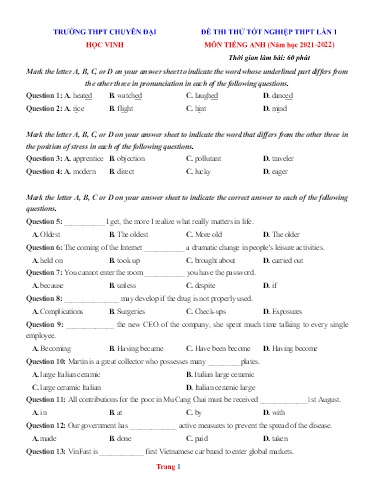
 TRƯỜNG THPT CHUYÊN ĐẠI ĐỀ THI THỬ TỐT NGHIỆP THPT LẦN 1
 HỌC VINH MƠN TIẾNG ANH (Năm học 2021-2022)
 Thời gian làm bài: 60 phút
Mark the letter A, B, C, or D on your answer sheet to indicate the word whose underlined part differs from
 the other three in pronunciation in each of the following questions.
Question 1: A. heated B. watched C. laughed D. danced
Question 2: A. rice B. flight C. hint D. mind
Mark the letter A, B, C, or D on your answer sheet to indicate the word that differs from the other three in
the position of stress in each of the following questions.
Question 3: A. apprentice B. objection C. pollutant D. traveler
Question 4: A. modern B. direct C. lucky D. eager
Mark the letter A, B, C or D on your answer sheet to indicate the correct answer to each of the following
questions.
Question 5: ___________ I get, the more I realize what really matters in life.
 A. Oldest B. The oldest C. More old D. The older
Question 6: The coming of the Internet ___________ a dramatic change in people's leisure activities.
 A. held on B. took up C. brought about D. carried out
Question 7: You cannot enter the room ___________ you have the password.
 A. because B. unless C. despite D. if
Question 8: _______________ may develop if the drug is not properly used.
 A. Complications B. Surgeries C. Check-ups D. Exposures
Question 9: _____________ the new CEO of the company, she spent much time talking to every single
employee.
 A. Becoming B. Having became C. Have been become D. Having become
Question 10: Martin is a great collector who possesses many _________plates.
 A. large Italian ceramic B. Italian large ceramic
 C. large ceramic Italian D. Italian ceramic large
Question 11: All contributions for the poor in Mu Cang Chai must be received _____________1st August.
 A. in B. at C. by D. with
Question 12: Our government has _____________ active measures to prevent the spread of the disease.
 A. made B. done C. paid D. taken
Question 13: VinFast is ____________ first Vietnamese car brand to enter global markets.
 Trang 1
 A. a B. Ø (no article) C. the D. an
Question 14: Jane's parents will certainly go __________ when she buys them a present with her first salary.
 A. apples B. oranges C. cucumbers D. bananas
Question 15: Someone has just arrived, _________ ?
 A. doesn't he B. does he C. haven't they D. have they Letnamnet
Question 16: I wasn't surprised at his response, it was perfectly ______________
 A. understood B. understanding C. understandably D. understandable
Question 17: That rising star won't appear in the commercial ________________
 A. until the contract has been signed B. once the contract will be signed
 C. after the contract was signed D. when the contract had been signed
Question 18: ___________ wisdom has it that higher oil prices are bad for economic growth.
 A. Great B. Popular C. Complex D. Modern
Question 19: While Peter ____________ last night, he got a nightmare.
 A. slept B. had slept C. is sleeping D. was sleeping
Mark the letter A, B, C or D on your answer sheet to indicate the word CLOSEST in meaning to the
underlined word in each of the following questions.
Question 20: There are two choices available to you: work hard on improving your grades or consider
changing your course.
 A. decisions B. methods C. options D. roads
Question 21: It is usually economical to buy washing powder in large quantities.
 A. money-saving B. money-wasting C. time-saving D. time-consuming
Mark the letter A, B, C or D on your answer sheet to indicate the word(s) OPPOSITE in meaning to the
underlined word(s) in each of the following questions.
Question 22: The trees were bare and leafless, but the snow made them a sight for sore eyes.
 A. an unpleasant thing to see B. poor eyesight
 C. good eyesight D. a pleasant thing to see
Question 23: Council members strongly objected to plans to sell off the land, didn't they?
 A. disagreed B. approved C. refused D. argued
Mark the letter A, B, C, or D on your answer sheet to indicate the sentence that best completes each of the
following exchanges.
Question 24: Minh and Nguyen are talking about an accident.
 Trang 2
- Minh: “No one was seriously injured in the crash last night"
- Nguyen: “ __________”
 A. Thanks a lot B. Never mind C. What a relief D. Poor them
Question 25: Trang is asking Ngoc for something to eat.
- Trang: "Can I have some of your popcorn?"
- Ngoc: “______________”
 A. Here you go. B. Same to you. C. Don't mention it. D. None of your business.
Read the following passage and mark the letter A, B, C, or D on your answer sheet to indicate the correct
word or phrase that best fits each of the numbered blanks from 26 to 30.
According to a recent study of teenagers, (26) ____________ of them do not do housework just for pocket
money. While many do household chores because they see it as a way of getting ready for adult life, others
feel they have a (27)___________ to help their parents because it is fair, especially if their parents work.
More than two-thirds of the young people (28)_____________were surveyed clean floors at least once a
week and more than 80% regularly set the table for meals or do the washing-up. Girls are more likely than
boys to wash their own clothes.
There are, (29) __________, a few teens who only do the housework because they are made to by their
parents. They argue that they should not be expected to help out at home because in their view, their teenage
years are a period which should be enjoyed rather than (30) ____________ with household responsibilities.
 (Adapted from Complete First for Schools by Guy Brook-Hart)
Question 26: A. much B. most C. few D. every
Question 27: A. burden B. contract C. function D. duty
Question 28: A. that B. whom C. which D. when
Question 29: A. therefore B. however C. otherwise D. besides
Question 30: A. suffered B. confused C. associated D. interrupted
Read the following passage and mark the letter A, B, C, or D on your answer sheet to indicate the correct
answer to each of the questions from 31 to 35.
 Humans have always been searching for quicker and easier ways to get around. About 10,000 years ago,
we built canoes made from logs of wood, while on land we started riding horses around 4.000 BC. Roughly
500 years later, we invented the wheel, which led to carts and wagons, and at almost the same time, the
Egyptians invented the sailing boat.
 Up until the 18th century most people travelled by sailing boat, horse or stagecoach, but in 1769, there was
a major breakthrough when the Scottish inventor James Watt invented the steam engine. In 1783, the French
inventor Claude de Jouffroy used this to build the first steamboat, and in 1804 the Englishman Richard
 Trang 3
Trevithick constructed the first steam-powered train. Railways helped carry coal around Britain and were an
important part of the Industrial Revolution.
 Another major breakthrough came when Karl Benz built the first working car in 1885. Then, in 1903,
Orville and Wilbur Wright built the first aeroplane. These two inventions shaped the 20th century. Over time,
cars and plane travel became cheaper so that by the 70s a lot of families owned a car and many were
holidaying abroad.
 Nowadays, companies are developing self-driving cars and we will soon be able to take trips into space.
The fascinating story of transportation continues and who knows how we'll be getting around in the future.
 (Adapted from On Screen Bl by Jenny Dooley and Virginia Evans)
Question 31: What is the passage mainly about?
 A. Development Trends of Transportation B. Positive Changes to Transportation
 C. Key Inventors in Transportation D. Impacts of Transportation over Time
Question 32: Which of the following is NOT mentioned in paragraph 1 as early means of transport?
 A. wagons B. canoes C. horses D. trains
Question 33: The word "this” in paragraph 2 refers to __________
 A. steamboat B. steam engine C. breakthrough D. inventor
Question 34: The word “holidaying“ in paragraph 3 is closest in meaning to ___________
 A. travelling B. studying C. working D. exercising
Question 35: According to the passage, most of the breakthroughs in transportation came _____________
 A. after the 20th century B. more than 10,000 years ago
 C. before the 19th century D. from the 18th century onwards
Read the following passage and mark the letter A, B, C or D on your answer sheet to indicate the correct
answer to each of the questions from 36 to 42.
 A survey into the media habits of teenagers in the USA reveals some surprising statistics. The average
teenager spends an incredible eleven hours each day on their mobile phones, computers, games consoles or
TVs. That's more hours than they are awake outside school time! How are they able to do this? The answer,
of course, is multitasking.
 The results of the survey came as no surprise to fifteen-year-old participant Jake Kendall. He told
researchers that he multitasked every second that he was online. He said that he was completing their survey
at the same time as watching a TV show, chatting to friends online and reading reviews of the latest film
releases. For sixteenyear-old Marisa Sanchez, the survey simply confirmed the facts. She said that she had
watched two hours of TV in the three hours since the end of school, and also researched her homework about
volcanoes, played an online game for two hours, and arranged her weekend plans by texting friends.
 Some experts are worried about the survey results. Sylvia de Lupis of the Family Action Institute told our
 Trang 4
reporter that teenagers would have difficulties because of their multitasking habits. She added that, as adults,
they would struggle to focus their attention. However, Dr Michael Rich from the Center on Media and Child
Health said that worries about multitasking had become pointless a long time ago, and that high levels of
media use were now a part of young people's environment, 'like the air that they breathe, the water that they
drink and the food that they eat'.
 (Adapted from Insight by Jayne Wildman and Fiona Beddall)
Question 36: Which of the following is the best title for the passage?
 A. Teens: More Media Use Than Hours in The Day
 B. The Art of Multitasking: A to Z for Teens
 C. Teens: Learning through Media
 D. Multitasking - of Teens' Everyday Life
Question 37: According to paragraph 1, which device may not be used daily by teens?
 A. game consoles B. televisions C. e-book readers D. phones
Question 38: The word “reviews" in paragraph 2 is closest in meaning to _______________
 A. comments B. plots C. discussions D. complaints
Question 39: The word "they" in paragraph 3 refers to __________
 A. habits B. adults C. difficulties D. teenagers
Question 40: The word “pointless" in paragraph 3 is closest in meaning to _________
 A. useful B. invaluable C. worthless D. ineffective
Question 41: Which of the following is NOT true according to the passage?
 A. An average teen in America spends nearly half a day using media.
 B. Marisa Sanchez could complete her school assignment and relax at the same time.
 C. Dr Michael Rich expected teenagers to get distracted due to multitasking.
 D. Frequent media use is possibly a matter of course to young people.
Question 42: Which of the following can be inferred from the passage?
 A. Family Action Institute must work to stop multitasking.
 B. Young people should concentrate on only one medium at a time.
 C. Jake Kendall and Marisa Sanchez got good academic results.
 D. Youngsters' multitasking habits in media use meet with mixed reactions from the public.
Mark the letter A, B, C, or D on your answer sheet to indicate the underlined part that needs correction in
each of the following questions.
Question 43: Among the world's 44 richest countries, there had been almost no war since 1945.
 A. Among B. riches C. had D. since
 Trang 5
Question 44: Another summer is coming, so let's just relax and enjoy themselves.
 A. Among B. coming C. and D. themselves
Question 45: Basically speaking, firefighters wear protected clothing to reduce the risk of being burned.
 A. Basically B. protected C. to reduce D. of
Mark the letter A, B, C, or D on your answer sheet to indicate the sentence that is closest in meaning to
each of the following questions.
Question 46: "I will leave most of my fortunes to charity," she said.
 A. She said that she will leave most of her fortunes to charity.
 B. She said that she would leave most of her fortunes to charity.
 C. She said that I would leave most of my fortunes to charity.
 D. She said that I will leave most of my fortunes to charity.
Question 47: The last time they traveled with each other was two years ago.
 A. They didn't travel with each other two years ago.
 B. They traveled with each other for two years.
 C. They have traveled with each other since two years ago.
 D. They haven't traveled with each other for two years.
Question 48: It is compulsory for you to show your COVID-19 vaccination certificate on your arrival.
 A. You can't show your COVID-19 vaccination certificate on your arrival.
 B. You needn't show your COVID-19 vaccination certificate on your arrival.
 C. You must show your COVID-19 vaccination certificate on your arrival.
 D. You should show your COVID-19 vaccination certificate on your arrival.
Mark the letter A, B, C, or D on your answer sheet to indicate the sentence that best combines each pair of
sentences in the following questions.
Question 49: I put my smartphone on the table. The recruiter then called me back.
 A. Only after the recruiter had called me back did I put my smartphone on the table.
 B. Had it not been for the recruiter's call, I wouldn't have put my smartphone on the table.
 C. Not only did the recruiter call me back but I also put my smartphone on the table.
 D. Hardly had I put my smartphone on the table when the recruiter called me back.
Question 50: They intend to establish a bank of information. It will be accessible to the public.
 A. They intend to establish a bank of information which will be accessible to the public.
 B. A bank of information that will be accessible to the public they intend to establish.
 C. The public intend to establish a bank of information which will be accessible.
 Trang 6
 D. They intend to establish a bank of information where the public will be accessible.
 BẢNG ĐÁP ÁN
 1. A 2. C 3. D 4. B 5. D 6. C 7. B 8. A 9. D 10. A
 11. C 12. D 13. C 14. D 15. C 16. D 17. A 18. B 19. D 20. C
 21. A 22. A 23. B 24. C 25. A 26. B 27. D 28. A 29. B 30. D
 31. B 32. D 33. B 34. A 35. D 36. A 37. C 38. A 39. D 40. C
 41. C 42. D 43. C 44. D 45. B 46. B 47. D 48. C 49. D 50. A
 HƯỚNG DẪN GIẢI CHI TIẾT
1 (NB)
Kiến thức: Cách phát âm đuơi “ed”
Giải thích:
A. heated /ˈhiːtɪd/
B. watched /wɒtʃt/
C. laughed /lɑːft/
D. danced /dɑːnst/
Cách phát âm đuơi “ed”:
+ Đuơi “ed” được phát âm là /t/ khi động từ cĩ phát âm kết thúc là /tʃ/, /θ/, /ʃ/, /s/, /k/, /p/, /f/
+ Đuơi “ed” được phát âm là /ɪd/ khi động từ cĩ phát âm kết thúc là /t/, /d/
+ Đuơi “ed” được phát âm là /d/ với các trường hợp cịn lại
Phần gạch chân phương án A được phát âm là /ɪd/, cịn lại phát âm là /t/.
Choose A.
2 (NB)
Kiến thức: Cách phát âm “i”
Giải thích:
A. rice /raɪs/
B. flight /flaɪt/
C. hint /hɪnt/
D. mind /maɪnd/
Phần gạch chân phương án C phát âm là /ɪ/, cịn lại phát âm là /aɪ/.
Choose C.
 Trang 7
3 (NB)
Kiến thức: Trọng âm từ cĩ 3 âm tiết
Giải thích:
A. apprentice /əˈprentɪs/
B. objection /əbˈdʒekʃn/
C. pollutant /pəˈluːtənt/
D. traveler /ˈtrỉvələ(r)/
Phương án D cĩ trọng âm rơi vào âm tiết 1, cịn lại là âm tiết 2.
Choose D.
4 (NB)
Kiến thức: Trọng âm từ cĩ 2 âm tiết
Giải thích:
A. modern /ˈmɒdn/
B. direct /dəˈrekt/
C. lucky /ˈlʌki/
D. eager /ˈiːɡə(r)/
Phương án B cĩ trọng âm rơi vào âm tiết 2, cịn lại là âm tiết 1.
Choose B.
5 (TH)
Kiến thức: So sánh “càng càng ”
Giải thích:
So sánh “càng càng ”: The + so sánh hơn + S + V, the + so sánh hơn + S + V
So sánh hơn của “old” là “older”
Tạm dịch: Càng lớn tuổi, tơi càng nhận ra điều gì thực sự quan trọng trong cuộc sống.
Choose D.
6 (TH)
Kiến thức: Cụm động từ
Giải thích:
A. held on: giữ
B. took up: chiếm
C. brought about: gây ra
D. carried out: thực hiện
Tạm dịch: Internet ra đời đã kéo theo sự thay đổi mạnh mẽ trong các hoạt động giải trí của con người.
 Trang 8
Choose C.
7 (TH)
Kiến thức: Liên từ
Giải thích:
A. because + S + V: bởi vì (chỉ nguyên nhân)
B. unless + S + V: nếu khơng (câu điều kiện)
C. despite + N/ V_ing: mặc dù (chỉ sự nhượng bộ)
D. if + S + V: nếu (câu điều kiện)
Tạm dịch: Bạn khơng thể vào phịng nếu bạn khơng cĩ mật khẩu.
Choose B.
8 (TH)
Kiến thức: Từ vựng
Giải thích:
A. Complications (n): sự phức tạp, rắc rối, biến chứng
B. Surgeries (n): phẫu thuật
C. Check-ups (n): sự kiểm tra (sức khoẻ)
D. Exposures (n): phơi bày, phơi nhiễm
Tạm dịch: Các biến chứng cĩ thể phát triển nếu thuốc khơng được sử dụng đúng cách.
Choose A.
9 (TH)
Kiến thức: Mệnh đề phân từ
Giải thích:
Câu đầy đủ: After she had become the new CEO of the company, she spent much time talking to every single
employee.
Hai câu cĩ đồng chủ ngữ => rút gọn chủ ngữ mệnh đề chỉ thời gian bằng cách: bỏ liên từ và chủ ngữ, khi câu
ở dạng chủ động đưa động từ về dạng “Having P2” để nhấn mạnh hành động xảy ra trước hành động ở mệnh
đề chính
Câu rút gọn: Having become the new CEO of the company, she spent much time talking to every single
employee.
Tạm dịch: Sau khi trở thành Giám đốc điều hành mới của cơng ty, cơ đã dành nhiều thời gian để nĩi chuyện
với từng nhân viên.
Choose D.
10 (TH)
Kiến thức: Trật tự tính từ
 Trang 9
Giải thích:
Khi cĩ nhiều tính từ cùng đứng trước 1 danh từ, sắp xếp chúng theo thứ tự: OSASCOMP + N. Trong đĩ:
O – opinion: quan điểm
S – size: kích thước
A – age: độ tuổi
S – shape: hình dạng
C – colour: màu sắc
O – origin: nguồn gốc
M – material: chất liệu
P – purpose: mục đích
N – noun: danh từ
Nếu cĩ số thứ tự => đứng trước tính từ & danh từ
=> Trật tự tính từ và danh từ: “large” – chỉ kích thước + “Italian” – chỉ nguồn gốc + “ceramic” – chỉ chất liệu
Tạm dịch: Martin là một nhà sưu tập vĩ đại, người sở hữu nhiều đĩa gốm lớn của Ý.
Choose A.
11 (TH)
Kiến thức: Giới từ
Giải thích:
A. in (prep): trong (+ tháng/ mùa/ năm/ )
B. at (prep): tại (+ dịp lễ/ giờ giấc/ )
C. by (prep): trước lúc
D. with (prep): với
Tạm dịch: Tất cả các khoản đĩng gĩp cho người nghèo ở Mù Cang Chải phải được nhận trước ngày 1 tháng
tám.
Choose C.
12 (TH)
Kiến thức: Từ vựng
Giải thích:
A. made (P2): tạo ra, làm
B. done (P2): làm
C. paid (P2): trả
D. taken (P2): lấy, cầm
=> cụm: take measures: thực hiện các biện pháp
Tạm dịch: Chính phủ của chúng ta đã thực hiện các biện pháp tích cực để ngăn chặn sự lây lan của dịch
 Trang 10
bệnh.
Choose D.
13 (TH)
Kiến thức: Mạo từ
Giải thích:
Trước số thứ tự cần dùng mạo từ xác định “the”
Tạm dịch: VinFast là thương hiệu ơ tơ đầu tiên của Việt Nam gia nhập thị trường tồn cầu.
Choose C.
14 (VD)
Kiến thức: Thành ngữ
Giải thích:
A. apples (n): quả táo
B. oranges (n): quả cam
C. cucumbers (n): quả dưa chuột
D. bananas (n): quả chuối
Cụm: go bananas: trở nên bực mình, phấn khích
Tạm dịch: Cha mẹ của Jane chắc chắn sẽ rất thích khi cơ ấy mua cho họ một mĩn quà bằng tiền lương đầu
tiên của mình.
Choose D.
15 (TH)
Kiến thức: Câu hỏi đuơi
Giải thích:
Vế trước câu hỏi đuơi dạng khẳng định => câu hỏi đuơi dạng phủ định
Vế trước: Someone has just arrived => câu hỏi đuơi: haven’t they?
Tạm dịch: Một ai đĩ vừa đến phải khơng?
Choose C.
16 (TH)
Kiến thức: Từ loại
Giải thích:
A. understood (V_ed): đã hiểu
B. understanding (n): trí tuệ, sự hiểu biết
C. understandably (adv): cĩ thể hiểu được
D. understandable (adj): cĩ thể hiểu được
Sau động từ “be” điền tính từ
 Trang 11
Tạm dịch: Tơi khơng ngạc nhiên về câu trả lời của anh ấy, điều đĩ hồn tồn cĩ thể hiểu được.
Choose D.
17 (TH)
Kiến thức: Sự phối hợp thì
Giải thích:
A. until the contract has been signed: cho đến khi hợp đồng được ký kết
B. once the contract will be signed: khi hợp đồng sẽ được ký kết (mệnh đề chỉ thời gian dùng tương lai đơn
như mệnh đề chính => sai ngữ pháp)
C. after the contract was signed: sau khi hợp đồng đã được ký kết (thì quá khứ đơn khơng kết hợp với tương
lai đơn)
D. when the contract had been signed: khi hợp đồng đã được ký kết (thì quá khứ hồn thành khơng kết hợp
với tương lai đơn)
Sự phối hợp thì: S + will + V + until + S + V (chia thì hiện tại đơn / hiện tại hồn thành)
Diễn tả 1 hành động sẽ xảy ra trong tương lai
Tạm dịch: Ngơi sao đang lên đĩ sẽ khơng xuất hiện trong quảng cáo cho đến khi hợp đồng được ký kết.
Choose A.
18 (TH)
Kiến thức: Từ vựng
Giải thích:
A. Great (adj): tuyệt vời
B. Popular (adj): phổ biến
C. Complex (adj): phức tạp
D. Modern (adj): hiện đại
=> cụm: popular wisdom: quan điểm chung/ ý kiến chung
Tạm dịch: Thơng thường người ta cho rằng giá dầu cao hơn cĩ hại cho tăng trưởng kinh tế.
Choose B.
19 (TH)
Kiến thức: Thì quá khứ tiếp diễn
Giải thích:
Cấu trúc thì quá khứ tiếp diễn: While + S + was/ were + V_ing, S + V_ed
Diễn tả 1 hành động đang xảy ra thì một hành động khác xem vào
Tạm dịch: Trong khi Peter đang ngủ tối qua thì anh ấy gặp ác mộng.
Choose D.
20 (TH)
 Trang 12
Kiến thức: Từ đồng nghĩa
Giải thích:
choices (n): lựa chọn
A. decisions (n): quyết định
B. methods (n): phương pháp
C. options (n): lựa chọn
D. roads (n): con đường
=> choices = options: lựa chọn
Tạm dịch: Cĩ hai sự lựa chọn dành cho bạn: nỗ lực cải thiện điểm số của mình hoặc xem xét thay đổi khĩa
học.
Choose C.
21 (TH)
Kiến thức: Từ đồng nghĩa
Giải thích:
economical (adj): tiết kiệm
A. money-saving (adj): tiết kiệm tiền
B. money-wasting => khơng cĩ dạng thức này
C. time-saving (adj): tiết kiệm thời gian
D. time-consuming (adj): tốn thời gian
=> economical = money-saving: tiết kiệm
Tạm dịch: Thơng thường sẽ tiết kiệm khi mua bột giặt với số lượng lớn.
Choose A.
22 (TH)
Kiến thức: Từ trái nghĩa
Giải thích:
a sight for sore eyes: điều gì/ người khiến bạn cảm thấy vui vẻ, thoải mái
A. an unpleasant thing to see: một thứ khơng dễ chịu để nhìn ngắm
B. poor eyesight: thị lực kém
C. good eyesight: thị lực tốt
D. a pleasant thing to see: một thứ dễ chịu để nhìn ngắm
=> a sight for sore eyes >< an unpleasant thing to see
Tạm dịch: Cây cối trơ trụi lá, nhưng tuyết khiến chúng trở thành một cảnh tượng đẹp mắt.
Choose A.
23 (TH)
 Trang 13
Kiến thức: Từ trái nghĩa
Giải thích:
objected to: phản đối
A. disagreed (V_ed): khơng đồng ý
B. approved (V_ed): tán thành
C. refused (V_ed): từ chối
D. argued (V_ed): tranh cãi
=> objected to >< approved
Tạm dịch: Các thành viên hội đồng phản đối quyết liệt kế hoạch bán bớt đất phải khơng?
Choose B.
24 (TH)
Kiến thức: Ngơn ngữ giao tiếp
Giải thích:
Minh và Nguyên đang nĩi về một vụ tai nạn.
- Minh: “Khơng cĩ ai bị thương nặng trong vụ va chạm đêm qua.”
- Nguyên: “__________”
A. Cảm ơn rất nhiều
B. Đừng bận tâm
C. Thật nhẹ nhõm
D. Tội nghiệp cho họ
Choose C.
25 (TH)
Kiến thức: Ngơn ngữ giao tiếp
Giải thích:
Trang đang xin mĩn gì đĩ từ Ngọc để ăn.
- Trang: “Cho tớ xin vài miếng bỏng ngơ được khơng?"
- Ngọc: “______________”
A. Của cậu đây.
B. Cậu cũng vậy.
C. Khơng cĩ gì.
D. Khơng phải việc của bạn.
Choose A.
26 (TH)
 Trang 14
Kiến thức: Từ vựng
Giải thích:
A. much + of + mạo từ/ tính từ sở hữu/ + N khơng đếm được/ N đếm được dạng số ít: nhiều
B. most + of + mạo từ/ tính từ sở hữu/ + N khơng đếm được/ N đếm được dạng số nhiều/ đại từ: hầu hết
C. few + of + mạo từ/ tính từ sở hữu/ + N đếm được dạng số nhiều/ đại từ: vài
D. every + N đếm được dạng số ít: mỗi
According to a recent study of teenagers, (26) most of them do not do housework just for pocket money
money.
Tạm dịch: Theo một nghiên cứu gần đây về thanh thiếu niên, hầu hết họ khơng làm việc nhà chỉ vì tiền tiêu
vặt.
Choose B.
27 (TH)
Kiến thức: Từ vựng
Giải thích:
A. burden (n): gánh nặng
B. contract (n): hợp đồng
C. function (n): chức năng
D. duty (n): trách nhiệm
While many do household chores because they see it as a way of getting ready for adult life, others feel they
have a (27) duty to help their parents because it is fair, especially if their parents work.
Tạm dịch: Trong khi nhiều người làm việc nhà vì họ coi đĩ là cách để chuẩn bị cho cuộc sống trưởng thành,
những người khác cảm thấy họ cĩ nghĩa vụ giúp đỡ cha mẹ vì điều đĩ là cơng bằng, đặc biệt nếu cha mẹ họ
đi làm.
Choose D.
28 (TH)
Kiến thức: Đại từ quan hệ
Giải thích:
A. that + V: người mà/ cái mà (dùng để thay thế cho danh từ chỉ người/ vật, đĩng vai trị làm chủ ngữ)
B. whom + S + V: người mà (dùng để thay thế cho danh từ chỉ người, đĩng vai trị làm tân ngữ)
B. which + V: cái mà (dùng để thay thế cho danh từ chỉ vật, đĩng vai trị làm chủ ngữ)
C. when + S + V: khi mà (dùng để thay thế cho cụm từ chỉ thời gian)
More than two-thirds of the young people (28) that were surveyed clean floors at least once a week and more
than 80% regularly set the table for meals or do the washing-up.
Tạm dịch: Hơn 2/3 thanh niên được khảo sát lau sàn nhà ít nhất một lần một tuần và hơn 80% thường xuyên
 Trang 15
dọn dẹp bàn ăn hoặc giặt giũ.
Choose A.
29 (TH)
Kiến thức: Liên từ
Giải thích:
A. therefore, S + V: do đĩ (chỉ kết quả)
B. however, S + V: tuy nhiên (chỉ sự đối lập)
B. otherwise, S + V: nếu khơng thì
D. besides, S + V: bên cạnh đĩ (thêm ý)
There are, (29) however, a few teens who only do the housework because they are made to by their parents.
Tạm dịch: Tuy nhiên, cĩ một số thanh thiếu niên chỉ làm việc nhà vì chúng bị bố mẹ bắt làm.
Choose B.
30 (TH)
Kiến thức: Từ vựng
Giải thích:
A. suffered (P2): chịu đựng
B. confused (P2): bối rối
C. associated (P2): liên kết, liên hợp
D. interrupted (P2): gây gián đoạn
They argue that they should not be expected to help out at home because in their view, their teenage years are
a period which should be enjoyed rather than (30) interrupted with household responsibilities.
Tạm dịch: Chúng cho rằng khơng nên mong đợi chúng giúp việc nhà vì theo quan điểm của chúng, tuổi
thiếu niên là giai đoạn đáng được tận hưởng hơn là bị gián đoạn với những trách nhiệm trong gia đình.
Choose D.
Dịch bài đọc:
Nội dung dịch:
Theo một nghiên cứu gần đây về thanh thiếu niên, hầu hết họ khơng làm việc nhà chỉ vì tiền tiêu vặt. Trong
khi nhiều người làm việc nhà vì họ coi đĩ là cách để chuẩn bị cho cuộc sống trưởng thành, những người khác
cảm thấy họ cĩ nghĩa vụ giúp đỡ cha mẹ vì điều đĩ là cơng bằng, đặc biệt nếu cha mẹ họ đi làm.
Hơn 2/3 thanh niên được khảo sát lau sàn nhà ít nhất một lần một tuần và hơn 80% thường xuyên dọn dẹp
bàn ăn hoặc giặt giũ. Các bé gái thường tự giặt quần áo của mình hơn các bé trai.
Tuy nhiên, cĩ một số thanh thiếu niên chỉ làm việc nhà vì chúng bị bố mẹ bắt làm. Chúng cho rằng khơng
nên mong đợi chúng giúp việc nhà vì theo quan điểm của chúng, tuổi thiếu niên là giai đoạn đáng được tận
hưởng hơn là bị gián đoạn với những trách nhiệm trong gia đình.
 Trang 16
 (Adapted from Complete First for Schools by Guy Brook-Hart)
31 (VDC)
Kiến thức: Đọc hiểu
Giải thích:
Ý chính của bài là gì?
A. Xu hướng phát triển của giao thơng vận tải
B. Những thay đổi tích cực đối với giao thơng vận tải
C. Các nhà phát minh chính trong giao thơng vận tải
D. Tác động của giao thơng vận tải theo thời gian
Choose B.
32 (VD)
Kiến thức: Đọc hiểu
Giải thích:
Cái nào sau đây KHƠNG được đề cập trong đoạn 1 như là phương tiện giao thơng thời kỳ đầu?
A. wagons (n): toa xe
B. canoes (n): ca nơ
C. horses (n): ngựa
D. trains (n): tàu hỏa
Thơng tin: About 10,000 years ago, we built canoes made from logs of wood, while on land we started
riding horses around 4.000 BC. Roughly 500 years later, we invented the wheel, which led to carts and
wagons, and at almost the same time, the Egyptians invented the sailing boat.
Tạm dịch: Khoảng 10.000 năm trước, chúng ta đã chế tạo ca nơ làm từ các khúc gỗ, trong khi trên mặt đất,
chúng ta bắt đầu cưỡi ngựa vào khoảng 4.000 năm trước Cơng nguyên. Khoảng 500 năm sau, chúng ta đã
phát minh ra bánh xe, từ đĩ phát minh ra xe đẩy và toa xe, và gần như cùng lúc đĩ, người Ai Cập đã phát
minh ra thuyền buồm.
Choose D.
33 (VD)
Kiến thức: Đọc hiểu
Giải thích:
Từ “this” trong đoạn 2 đề cập đến __________
A. steamboat (n): tàu hơi nước
B. steam engine (n): động cơ hơi nước
C. breakthrough (n): đột phá
D. inventor (n): nhà phát minh
 Trang 17
Thơng tin: Up until the 18th century most people travelled by sailing boat, horse or stagecoach, but in 1769,
there was a major breakthrough when the Scottish inventor James Watt invented the steam engine. In 1783,
the French inventor Claude de Jouffroy used this to build the first steamboat, and in 1804 the Englishman
Richard Trevithick constructed the first steam-powered train.
Tạm dịch: Cho đến thế kỷ 18, hầu hết mọi người đi du lịch bằng thuyền buồm, ngựa hoặc xe ngựa, nhưng
vào năm 1769, đã cĩ một bước đột phá lớn khi nhà phát minh người Scotland James Watt phát minh ra động
cơ hơi nước. Vào năm 1783, nhà phát minh người Pháp Claude de Jouffroy đã sử dụng nĩ để chế tạo chiếc
tàu chạy bằng hơi nước đầu tiên, và vào năm 1804, một người Anh tên là Richard Trevithick đã chế tạo chiếc
tàu chạy bằng hơi nước đầu tiên.
Choose B.
34 (VD)
Kiến thức: Đọc hiểu
Giải thích:
Từ “holidaying” trong đoạn 3 gần nghĩa nhất với _____
holidaying (V_ing): đi nghỉ mát
A. travelling (V_ing): đi du lịch
B. studying (V_ing): học tập
C. working (V_ing): làm việc
D. exercising (V_ing): tập thể dục
=> holidaying = travelling
Choose A.
35 (VD)
Kiến thức: Đọc hiểu
Giải thích:
Theo đoạn văn, hầu hết các đột phá trong giao thơng vận tải đến _____________
A. sau thế kỷ 20
B. hơn 10.000 năm trước
C. trước thế kỷ 19
D. từ thế kỷ 18 trở đi
Thơng tin: - Up until the 18th century most people travelled by sailing boat, horse or stagecoach, but in
1769, there was a major breakthrough when the Scottish inventor James Watt invented the steam engine. In
1783, the French inventor Claude de Jouffroy used this to build the first steamboat, and in 1804 the
Englishman Richard Trevithick constructed the first steam-powered train.
- Another major breakthrough came when Karl Benz built the first working car in 1885. Then, in 1903,
Orville and Wilbur Wright built the first aeroplane.
 Trang 18
Tạm dịch: - Cho đến thế kỷ 18, hầu hết mọi người đi du lịch bằng thuyền buồm, ngựa hoặc xe ngựa, nhưng
vào năm 1769, đã cĩ một bước đột phá lớn khi nhà phát minh người Scotland James Watt phát minh ra động
cơ hơi nước. Vào năm 1783, nhà phát minh người Pháp Claude de Jouffroy đã sử dụng nĩ để chế tạo chiếc
tàu chạy bằng hơi nước đầu tiên, và vào năm 1804, một người Anh tên là Richard Trevithick đã chế tạo chiếc
tàu chạy bằng hơi nước đầu tiên.
- Một bước đột phá lớn khác xảy ra khi Karl Benz chế tạo chiếc ơ tơ hoạt động đầu tiên vào năm 1885. Sau
đĩ, vào năm 1903, Orville và Wilbur Wright đã chế tạo chiếc máy bay đầu tiên.
Choose D.
Dịch bài đọc:
Nội dung dịch:
 Con người luơn tìm kiếm những cách nhanh hơn và dễ dàng hơn để đi lại. Khoảng 10.000 năm trước,
chúng ta đã chế tạo ca nơ làm từ các khúc gỗ, trong khi trên mặt đất, chúng ta bắt đầu cưỡi ngựa vào khoảng
4.000 năm trước Cơng nguyên. Khoảng 500 năm sau, chúng ta đã phát minh ra bánh xe, từ đĩ phát minh ra
xe đẩy và toa xe, và gần như cùng lúc đĩ, người Ai Cập đã phát minh ra thuyền buồm.
 Cho đến thế kỷ 18, hầu hết mọi người đi du lịch bằng thuyền buồm, ngựa hoặc xe ngựa, nhưng vào năm
1769, đã cĩ một bước đột phá lớn khi nhà phát minh người Scotland James Watt phát minh ra động cơ hơi
nước. Vào năm 1783, nhà phát minh người Pháp Claude de Jouffroy đã sử dụng nĩ để chế tạo chiếc tàu chạy
bằng hơi nước đầu tiên, và vào năm 1804, một người Anh tên là Richard Trevithick đã chế tạo chiếc tàu chạy
bằng hơi nước đầu tiên. Đường sắt đã giúp vận chuyển than khắp nước Anh và là một phần quan trọng của
Cách mạng Cơng nghiệp.
 Một bước đột phá lớn khác xảy ra khi Karl Benz chế tạo chiếc ơ tơ hoạt động đầu tiên vào năm 1885. Sau
đĩ, vào năm 1903, Orville và Wilbur Wright đã chế tạo chiếc máy bay đầu tiên. Hai phát minh này đã định
hình thế kỷ 20. Theo thời gian, ơ tơ và việc đi lại bằng máy bay trở nên rẻ hơn nên đến những năm 70, rất
nhiều gia đình đã sở hữu một chiếc ơ tơ và nhiều người đã đi nghỉ ở nước ngồi.
 Ngày nay, các cơng ty đang phát triển ơ tơ tự lái và chúng ta sẽ sớm cĩ thể thực hiện các chuyến du hành
vào vũ trụ. Câu chuyện hấp dẫn về các phương tiện vẫn tiếp tục và ai biết được chúng ta sẽ đi lại như thế nào
trong tương lai.
 (Adapted from On Screen Bl by Jenny Dooley and Virginia Evans)
36 (VD)
Kiến thức: Đọc hiểu
Giải thích:
Tiêu đề nào sau đây là hay nhất cho đoạn văn?
A. Thanh thiếu niên: Sử dụng nhiều phương tiện truyền thơng hơn giờ trong ngày
B. Nghệ thuật Đa nhiệm: từ A đến Z cho Thanh thiếu niên
C. Thanh thiếu niên: Học qua phương tiện truyền thơng
D. Đa nhiệm - trong cuộc sống hàng ngày của thanh thiếu niên
 Trang 19
Choose A.
37 (VD)
Kiến thức: Đọc hiểu
Giải thích:
Theo đoạn 1, thiết bị nào khơng được sử dụng hàng ngày bởi thanh thiếu niên?
A. game consoles (n): máy chơi game
B. televisions (n): tivi
C. e-book readers (n): máy đọc sách điện tử
D. phones (n): điện thoại
Thơng tin: The average teenager spends an incredible eleven hours each day on their mobile phones,
computers, games consoles or TVs.
Tạm dịch: Một thanh thiếu niên trung bình dành 11 tiếng đáng kinh ngạc mỗi ngày trên điện thoại di động,
máy tính, máy chơi game hoặc TV.
Choose C.
38 (VD)
Kiến thức: Đọc hiểu
Giải thích:
Từ “reviews” trong đoạn 2 gần nghĩa nhất với _______
reviews (n): đánh giá
A. comments (n): bình luận
B. plots (n): nội dung
C. discussions (n): thảo luận
D. complaints (n): khiếu nại, phàn nàn
=> reviews = comments
Choose A.
39 (VD)
Kiến thức: Đọc hiểu
Giải thích:
Từ “they” trong đoạn 3 đề cập đến _____
A. habits (n): thĩi quen
B. adults (n): người lớn
C. difficulties (n): khĩ khăn
D. teenagers (n): thanh thiếu niên
Thơng tin: Sylvia de Lupis of the Family Action Institute told our reporter that teenagers would have
 Trang 20
File đính kèm:
- de_thi_thu_tn_thpt_mon_tieng_anh_12_lan_1_truong_thpt_chuyen.pdf
